What is a Chapter Lead?
Strategically the role supports and manages teams that work across different areas of the business, ensuring they are correctly resourced to deliver the agreed direction set by the business.
The people development focuses on uplifting those in their team so they continue to develop as individuals and grow in alignment with the business direction and helping to focus on improving the customer products or services they produce.
The title ‘Chapter Lead’ replaced the traditional ‘Head of’ role at many organisations as agile grew, but I have now seen a shift in moving back to a more traditional ‘Head of’ but with a more agile job approach to the leadership.
The job description of the Chapter Lead is a people leadership role that develops people in their chapter and ensures they are upskilled and best placed within an organisation to deliver customer products, projects or initiatives. They help to remove potential blockers across the business and provide personal and team development for their chapters’ craft through servant leadership, ensuring there is an environment for growth.
To understand where a Chapter Lead sits within an agile organisation, let’s look at the three traditional roles within an agile team/squad1

These traditionally make up the squad that delivers initiatives or particular tasks. There are multiple websites and information about these three roles (e.g., Atlassian) but less about the role of the Chapter Lead who manages these roles and helps to set the guidelines mentioned in Paul’s quote above. The Chapter Lead looks after a chapter of resources that specialise in a particular business craft of skill.
A Chapter Lead is not directly responsible for the task delivered by their chapter members, but they are responsible for ensuring that the processes and environment that they deliver in are optimal so they maximise efficiency. The role is a strategic team leader within the business whose measurement of success is not the immediate financial success of the product being created (the what) but the longer-term success of the team that delivers and constantly improves, which ultimately builds better products (the how).
How is the role different from a traditional manager?
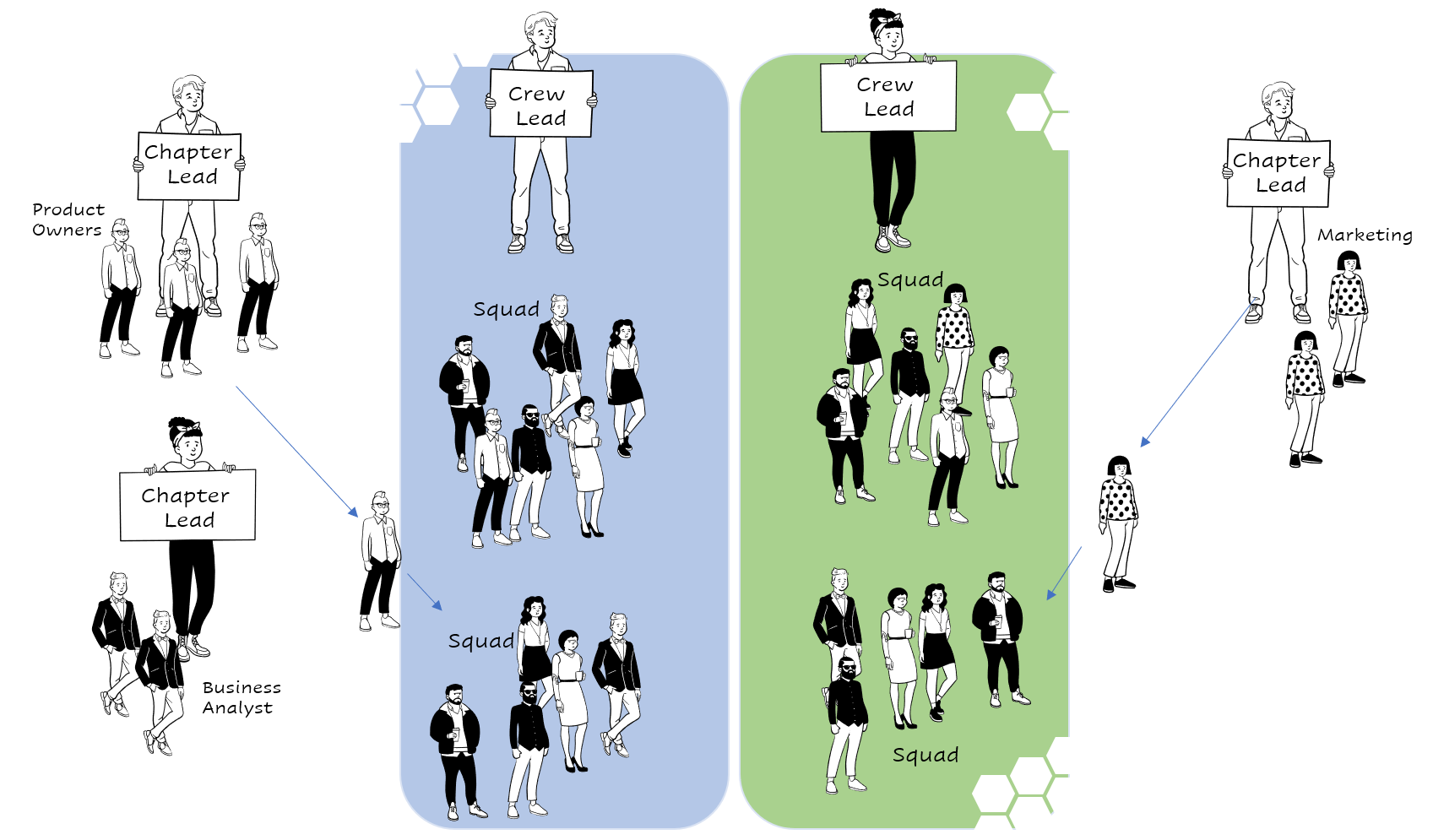
Traditionally, ‘Heads of’ line managers are responsible for the end-to-end performance of their team. From recruitment through to the work delivered, there is a top-down waterfall approach where what the manager says goes. While a Chapter Lead recruits and develops their chapter to ensure they are built for success, they do not dictate how their chapter members manage their work; this is down to the squads and crews that they are deployed to.
Traditionally a Crew, led by a Crew Lead (General Manager in a traditional org.) will make up a particular business stream within an organisation. e.g. Product, Finance. The Crew Lead determines the work to be carried out by the squads that make up that crew. The squads, under the guidance and agreement of their Product Owner, then prioritise their work and determine the order that they should deliver it to maximise benefit.
What is the benefit to the business?
Working together, Chapter Leads and Crew Leads are able to focus on two key business deliverables side by side, maximising delivery. The Product Owner, in consultation with the Crew Lead determines the delivery of the work required (the what) and the Chapter Lead focuses on ensuring that the processes are in place to provide sustainable delivery that also drives improvement (the how).
Traditional line managers need to manage both and quite often one is focused on at the expense of the other. (The ‘what’ usually wins)
This separation ensures additional focus on the ‘how’ by creating a sustainable workforce that drives a culture of development.
What is the benefit to members in your chapter?
In a traditional or non-agile business the line manager is measured on the work their staff need to deliver as well as their ongoing development. There is a natural conflict between the two because when it comes to focusing time on their teams’ professional development, the managers’ own business targets can often mean there is more of a desire to focus on completing more work than an even mix.
The separation also allows for honest conversations about the work and the squad environment because personal development of the chapter member is with the Chapter Lead, one step removed from the day-to-day workings of their squad. By being responsible for improving ‘the how’, there is a focus on career development and learning. This is where the success of the role lies. Concepts like People Development Days (see culture page) help to strengthen this approach and build a culture of continued learning and development, which translates into building better products.
1 While different organisations use different terminology for the benefit of this site, I will refer to teams managed by Product Owners as squads and any larger teams that these squads report into as crews.